

Rodrigo Diaz de Vivar was a Spanish knight born in the time 1043, and he is a public hero of Spain. He’s perhaps further considerably known as “ El Cid Campeador, ”( El Cid meaning The Lord, or Master, and Campeador meaning The Champion, an honorable title rarely given to a man during his continuance).
Once he came to a knight, Rodrigo soon distinguished himself in such a manner that he was appointed to be the commander of the Castilian army under King Sancho II. Rodrigo proved himself in several battles in which the Castilian army was always victorious under his suitable leadership, and it was during this time that he earned the title El Cid.
King Sancho was bobbled in 1072, and his youthful family, Alfonso, came to the throne. As it was considerably suspected that Alfonso was responsible for Sancho’s death, Rodrigo made him privately swear and pledge that he’d nothing to do with his family’s death before he’d admit him as his king. In a truly dramatic scene, Alfonso swore that he was innocent of his family’s blood and was thus accepted as king of Castile. Indeed though the pledge had gained him the willing acceptance of his vassals, King Alfonso held it against the Cid that he’d privately challenged him, and so on the first occasion, he unjustly exiled Rodrigo from Castile.
Buy your dupe of El Cid, God’s Own Champion now for only$16.95 US plus dispatching
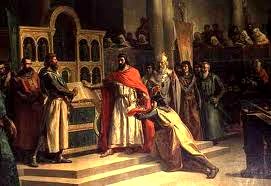
Earning the hostility of King Alfonso for abetting the Cid, Rodrigo’s companions swore their fastness to a lord who no longer held any lands or goods. Like the Cid, they left titles and property behind to endure a life of wandering and query. With these numerous men, Rodrigo fulfilled multitudinous magnific deeds, surviving by his capability as a general and his skill at arms, until he eventually conquered the municipality of Valencia.
The great Almoravid incursion of the Iberian Peninsula passed in the time 1086, and King Alfonso was soundly defeated by the Muslim army. As time proved, King Alfonso was simply not suitable for defeating the Muslim general Yusuf. There was only one man who could master him, and that man was the Cid, but King Alfonso continued to do his utmost to try to destroy him. His particular excellence incited covetousness in those who weren’t so blessed by God, and there were important men who despised and blackened him. In face of this visionless, nasty covetousness, the Cid showed neither despondency nor hostility. When exiled, he sought no direct vengeance, still, much he was entitled to do so; nor did he, like Achilles, grouch in his roof and expedient for the defeat of his detractors. On the negative, he constantly went to the help of the King who had exiled him and, in malice of a series of rebuffs from his countrymen, took the only staid course left open to him; he withdrew his invaluable energy to a distant field where covetousness and confusion couldn’t reach him, but where he could still so- operate.
He was also forced at times to fight against other Christian armies that attacked him, generally for reasons of particular covetousness, but Rodrigo also defeated those armies. By the time of his death of natural causes on July 10, 1099, he commanded the respect indeed of his adversaries, as his capability as a warrior was so extraordinary that upon his death a Muslim chronicler accredited him, “ a miracle among the great cautions of the Almighty. ”
multitudinous tales were told throughout Europe about the days of the Cid, and the events of his life were flashed back and celebrated long after his death. This isn’t surprising, as he was a knight who was noway defeated under any circumstances, in any situation, by any man or any group of men.
As a grand hero, the Cid stands in a class by himself. His deeds while in exile were mighty. Consider, for case, Rodrigo’s triumph over Valencia. It savors of madness that a single man, unwarranted by any public association and lacking resources indeed for a day, should appear before Valencia determined upon restoring a rule that had been overthrown this alternate time by an adversary who had proved contagious to the strongest power in Spain; that he should dream of doing what the Christian Emperor had failed to do and in the teeth of the Moslem Emir’s opposition that memorable day in October 1092, when he leveled his will- power against all the chances and changes of fortune, marks the peak of heroism. The Aragonese chronicler, Zurita, wrote “ it was the most extraordinary achievement ever performed in Spain by anyone but a king. ”
The Carmen Roderick, a story of the Cid’s life, was begun during his continuance, and the Poem of the Cid was completed soon after his death. They emphasize in their simple language his rates in war and the extraordinary powers of one who solely by the strength of his potent arm rose from the condition of a racked knight to be the most important man on earth who conceded a king.
Rodrigo, stout of heart as ever, assured and strengthened his colors in a mannish fashion and constantly appealed devoutly to the Lord Jesus Christ that He’d shoot godly aid to his people. He knew now how he might master the adversary, but he’d have to hold on for a while to do it.
There had noway truly been any distrustfulness in Rodrigo’s mind about the outgrowth of battle, for when he saw Jimena pale with fear upon hearing the Almoravide drums for the first time, he told her that in two weeks he’d lay them at her bases, and also make them votive sacrifice to the Blessed Abecedarian Mary.
Day after day the conflict went on in a similar manner with the Africans making attacks on the municipality, and each day the fighting was renewed with unabated vigor, but far and wide the valorous Cid was to be set up, encouraging his men, in the words of the Christian chronicler, by the natural fiber of his heart and egging one and all to keep on soliciting to the Almighty for help. The Cid remained on the guard for ten days, noway formerly making any kind of assault against the Africans.
Reviews for” El Cid, God’s Own Champion”
History. Battles. Strategy. also’s a book that throws some light on Spain’s dark ages – the growth of the Visigoths. El Cid, born Rodrigo Diaz, was the great Spanish hero of the eleventh century. This was the century of the First crusade to the Holy Land, but Rodrigo Diaz was fighting his own crusade, saving the floated northern half of the Iberian Peninsula from Moslem domination. It wasn’t until nearly 500 times subsequently that the last of the Moors were expelled from Spain by Queen Isabella the Catholic, but neither Aragon nor Castile would have continued to live as unqualified businesses had it not been for El Cid.


